
Loveland Directory Shelf
The local shelf and the regional digital collection overlap without being identical. The Loveland Public Library at 300 N Adams and the Loveland Museum at 503 N Lincoln are local starting points. The Fort Collins History Connection holds regional scans and physical archive copies. Most listed municipal directory volumes have scans, while 2006-present availability is a stated exception and the collection has gaps.
| Collection | Years | Where Held | Access |
|---|---|---|---|
| Loveland municipal directories | Most years 1904-present, with gaps | Loveland Library and Loveland Museum | Staff-assisted; some volumes are at the museum |
| Regional directories | 1902-present listed runs, with gaps | History Connection scans and physical archive | Listed volumes scanned except 2006-present |
| Reverse or cross-reference directories | Strongest identified 1985-2005 | History Connection and ContentDM | Address-to-name route; verify each volume |
| Telephone books | 1927-present listed runs | History Connection and library collections | Useful bridge; not occupancy proof |
| Newspaper and card index | Most local titles since 1891 | Loveland Public Library and CHNC | Search, microfilm, scan, or copy route |
The regional run includes 1902, 1903, 1904, 1906, 1907, 1908, 1909/10, 1910/11, 1913/14, 1917, 1919, 1922, 1925, 1927, 1929, 1931, 1933, 1934, 1936, 1938, 1940, 1948, 1950, 1952, 1954, 1956-60, 1962-64, 1966, 1968-73, 1975-77, and 1979-80-present with gaps. The 1941-47 directory gap is real in the identified collection, but telephone books cover much of it.
Directory Start in 1904
The local historic-building guide describes these volumes with names, addresses, and occupations for most years from 1904 to the present. That statement describes a surviving collection, not a guarantee that every annual volume or every household appears. Some volumes are at the museum, so a library search may end with a reference request or a visit to the other local custodian.
Publishers change across the run. Polk, Courier, Johnson's, and Cole titles use different page designs and abbreviations. The directory collection also includes county and rural material, so a Loveland result may represent a postal or rural service area wider than the incorporated city. Keep the title, year, section, and page with every name.
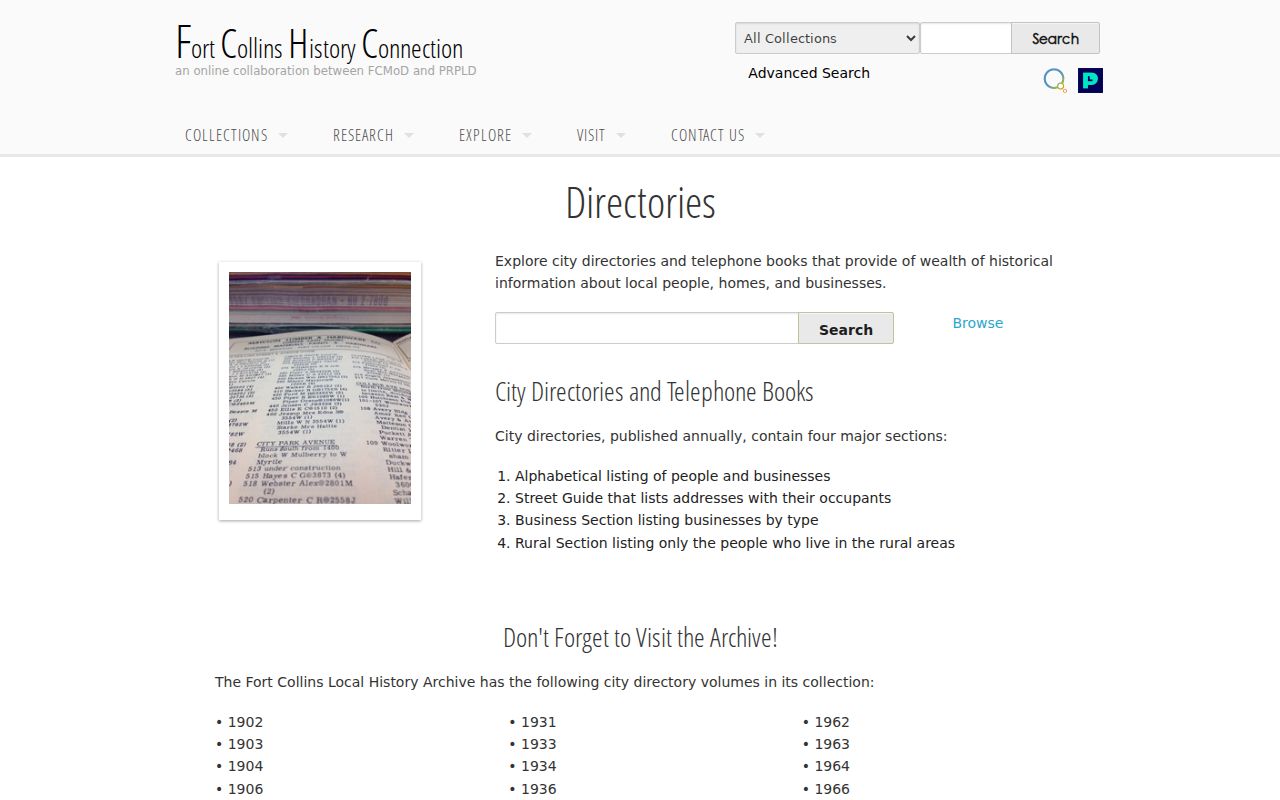
The digital collection can be approached through a collection selector, free-text search, Advanced Search, or Browse. Its categories also include photographs, maps, oral histories, reference books, vertical files, permits and records, biographies, journals, scrapbooks, and exhibits. A directory hit may therefore lead to related property material, but the related item still needs its own title, date, and page citation.
The 1925 Polk Loveland Page
The History Connection directory collection preserves the R.L. Polk Directory Co.'s Fort Collins, Loveland and Larimer County Directory. The 1925 volume has a Loveland Rural Routes heading and contains name blocks, route or address fields, cross-references, and business advertisements. It is a good example of why a printed directory needs its section title read before a name is treated as a city resident.
The digital directory collection preserves the publisher and collection context around the scan. A rural-route page can supply a valuable historical lead, but it may not use the same street naming, postal boundary, or address format found in a later Loveland historical directory.
Reading a Loveland Directory Entry
A directory entry is a compact historical record. Read the surname and given-name line first, then note the address, route, phone, occupation or business clue, spouse or household notation, and any from or see cross-reference. The page, year, publisher, and section are part of the evidence. An abbreviation key should be read before initials or occupancy marks are decoded.
| Surname and given name | Alphabetical name block, often with an initial or shortened given name. |
|---|---|
| Spouse or household | Parentheses, widow notation, or another household clue when the volume supplies one. |
| Street or rural route | House number, street wording, route, or a rural address for that volume. |
| Occupation or business | A historical descriptor that can separate two similar names. |
| Proprietor | A business-section role, not proof of a private residence. |
| Telephone | Number or exchange as printed in the year-specific volume. |
| From or see | Cross-reference to a prior address, name form, or related listing. |
| Occupancy marks | Decode only from that volume's abbreviation key; no universal meaning is assumed. |
| Page, year, section | The citation needed to return to the same entry and interpret its context. |
- Criss-cross directory
- A reverse section arranged by street or address so a place can lead to a listed name.
- Householder index
- A name or household finding aid that may point to an entry without listing every person at the address.
- Abbreviation key
- The volume's local legend for initials, direction, occupation, phone, route, or cross-reference marks.
Loveland Directory Sections
Regional volumes commonly divide the search into alphabetical people and businesses, a Street Guide, a business section by type, and a rural section. Start with the alphabetical section for a known name. Use the Street Guide or reverse pages for a known address. Check the business or rural section when a person is tied to a proprietor line, route, farm, or local enterprise.
The 1904, 1906, and 1907 regional volumes lack a Street Guide. That absence changes the search order: use the alphabetical pages, newspaper index, telephone book, map, or deed clue instead of assuming that an address-to-name route exists. Page design also changes when the publisher moves from Polk or Courier to Johnson's or Cole.
Loveland Cross-Reference Years
Cross-reference directories are the strongest identified address-to-name route for 1985-2005, with annual and biannual title variants. They can help when an alphabetical search misses a former spelling or when the address is known but the name is not. Use the street entry, then check the alphabetical section and a neighboring year rather than treating one line as a complete history.
Later Cole Fort Collins, Loveland and vicinity volumes resemble phone-book style records, while earlier reverse titles have their own labels and gaps. Save the exact title and page. A changed street number, rural route, directional, or postal label can make two entries look different even when a plat, deed, or map shows continuity.
1941-47 Loveland Telephone Bridge
No known Loveland municipal directories were located for 1941-47. Telephone runs cover much of that gap, including 1941-49, and the broader telephone sequence includes 1927, 1927/28, 1934-40, 1951-57, 1959/60, and 1962-present. A telephone listing can preserve a name, phone, address, or business clue when a city directory is absent.
Telephone books do not prove that every household member lived at the listed address, and a business line may describe a place of service rather than a home. Compare a bridge entry with newspaper microfilm, a census year, a deed, a map, or a later directory. The gap is a reason to widen the source set, not to invent a missing annual volume.
Loveland Newspapers Since 1891
The Loveland Public Library keeps newspaper microfilm for most local titles since 1891 and maintains an obituary, birth, name-change, and significant-event card index. Copies can be printed or scanned for a fee. The Colorado Historic Newspapers Collection provides more than 1.97 million pages, more than 493 titles, and coverage from 1859 through 2020, subject to the title and page actually being digitized.
Newspaper clues can explain a move, death, marriage, business change, or former address that a city directory leaves unexplained. Sanborn maps add building footprint, use, materials, and street context for 1886, 1890, 1893, 1900, 1906, 1911, 1918, 1927, 1937, and 1946. Neither source is a complete resident list, so retain the paper title, date, page, map year, and address wording.
Tracing Loveland Directory History
Family history works best when each directory year is treated as one dated observation. Start with the known address or name, record the exact spelling and page, then pair the entry with a public census, newspaper, deed, cemetery, or archive clue. The 1950 census is public under the 72-year rule, while 1960 is scheduled for release in 2032. Directories fill the years between those census points but can omit people or carry an old address.
- Choose the earliest credible Loveland historical directory or regional volume and cite its title, year, section, and page.
- Follow the name forward and backward, recording moves, spouse or household notation, phone, route, and business clues.
- Use the Street Guide or cross-reference section to test the address, then compare the legal description or parcel when a modern match exists.
- Pair the directory years with the nearest public census and newspaper index, allowing for boundary and spelling changes.
- Close a former-resident trail with an obituary, cemetery record, probate lead, or archive request, keeping historical evidence separate from current contact.
For modern address-keyed records, pair the historical citation with the Loveland by-street workflow. A disappearance can mean a move, death, omission, changed route, or a missing volume. Only a second source can distinguish those possibilities.
Loveland Library and Museum Trail
Loveland's library history gives the collection a local anchor. Library roots reach 1901 and 1905, the Carnegie building dates to 1908, and the current facility at 300 N Adams dates to 1987. The reference desk can point to directories, microfilm, local-history books at 978.868, vertical files on people, families, and properties, historic maps, and research assistance. Museum property record cards may add a small photo, floor plan, owner, and legal description for a historic property.
The Colorado State Archives finding aid adds Larimer naturalizations from 1872-1906, district-court series from 1868, probate, indexes, fee books, and delayed births from 1942-65 that are closed. An archive catalog or library card is a route to a collection, not a complete name result. Ask the custodian for the copy or reference process when a scan does not contain the needed page.
| 1901 and 1905 | Library roots identified in the city's later history material. |
|---|---|
| 1908 | Carnegie library building milestone. |
| 1987 | Current 300 N Adams library facility milestone. |
The Colorado Archives finding aid and the library's local research page keep the historical shelf connected to its custodians.